

What is a dental implant?
A dental implant is a small artificial root made of titanium, placed in the jawbone where the tooth is missing. Once it has bonded with the bone (a process called osseointegration), it supports a crown, a bridge or helps to stabilise a removable denture.
Unlike a conventional bridge, it does not require the neighbouring teeth to be filed down. And because it transmits chewing forces to the bone, it helps to preserve bone volume, which otherwise gradually shrinks after a tooth is lost.
Who is it for?
- one or more missing teeth, or a tooth that has to be extracted;
- a bridge or removable denture that is uncomfortable, moves or causes sore spots;
- complete tooth loss, to secure or stabilise a denture.
Smoking, poorly controlled diabetes or active periodontitis are not necessarily contraindications, but they need to be addressed before or during treatment. That is precisely what the initial assessment is for.
What happens at the practice
1. Assessment and 3D imaging
Everything starts with a clinical examination and a Cone Beam (CBCT) 3D scan of the jaws, taken on site at the practice. It allows the volume and density of the bone to be measured precisely, and the structures to be avoided (nerve, sinus) to be identified. The procedure is planned on these images, and you are given a detailed written estimate.
2. Placement, without a flap or stitches
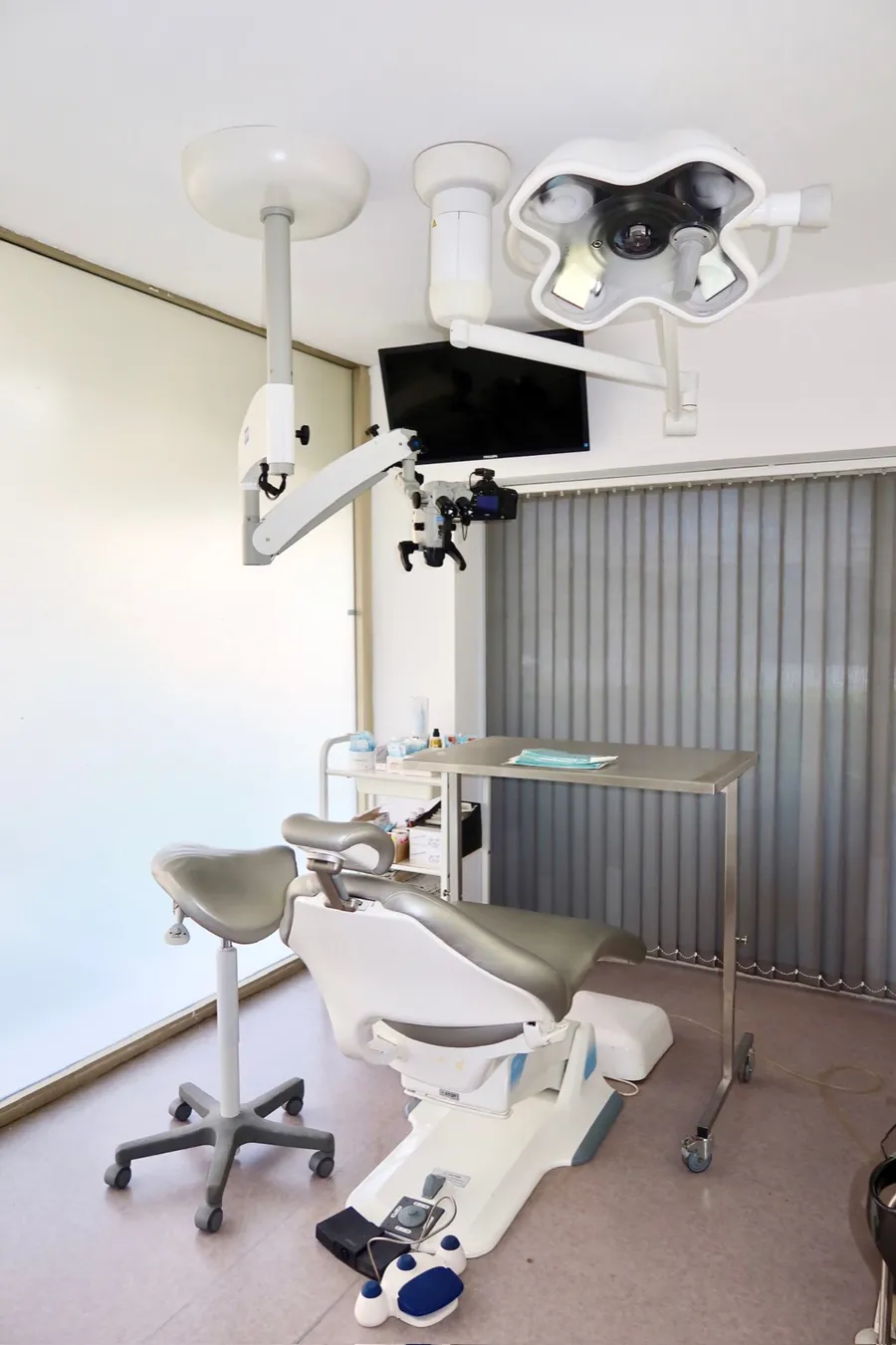
In a conventional approach, the gum is opened (a “flap is raised”) to reach the bone, then closed again with stitches. At the practice, the implant is placed through the gum, using the laser and 3D planning: no incision, no stitches, no visible scar. Rather than removing bone, the bone is condensed or widened around the implant, which improves its initial stability.
3. Healing and the crown
Depending on the stability achieved, a temporary crown may be fitted on the same day or after a few weeks. The permanent crown, made of ceramic (zirconia or lithium disilicate, metal-free), is produced from a digital impression taken with an intraoral camera, without impression paste, generally around two months later.
After the procedure
Without an incision, swelling, bleeding and visible signs of the procedure are greatly reduced; most patients return to their usual activities the following day. You will be given a few simple instructions: a soft diet for the first few days, no smoking, mouthwash as prescribed, and a follow-up appointment to check healing.
Please note: every situation is different. The exact protocol (number of stages, time before the permanent crown) is defined at the assessment, based on the 3D scan.
Fees and insurance cover
The cost of implant treatment depends on the number of implants, the type of crown and the bone situation. In France, the implant itself is not reimbursed by the national health insurance (Assurance Maladie); the crown fitted on the implant is partially covered, and many top-up health insurance policies (mutuelles) reimburse part of the treatment. The detailed estimate provided after the assessment tells you what you will have to pay yourself before you commit. Patients insured abroad should check their cover with their own insurer. The practice accepts bank cards, cheques and cash.
Care and lifespan
An implant cannot decay, but the gum and bone around it can become inflamed (peri-implantitis), just as around a natural tooth. Careful brushing, cleaning between the teeth and regular check-ups at the practice are the best way to make it last. If you have gum disease, it must be treated first: see periodontitis.
Frequently asked questions
Is having an implant placed painful?
The procedure is carried out under local anaesthetic. As the gum is not opened and no stitches are needed, recovery is generally straightforward: some moderate tenderness for the first few days, relieved by simple painkillers.
How long does a dental implant last?
When well looked after and checked regularly, an implant can last for many years, often several decades. Smoking, untreated periodontitis and inadequate oral hygiene are the main risk factors.
Can an implant be placed straight after a tooth is removed?
Yes, when the clinical situation allows: the extraction, the implant placement and a temporary crown can all be carried out on the same day. See the immediate implant.
Is a bone graft always necessary?
No, not in most cases. The bone is worked by condensation and expansion, and the practice does not use bone substitutes of animal or human origin. See implants without a bone graft.
How much does a dental implant cost?
The cost depends on the number of implants, the type of crown and your bone situation. A detailed, free written estimate is provided after the assessment, before you commit to anything.
This information is general and does not replace a consultation: only a clinical and radiological examination can determine the right treatment for your situation.